


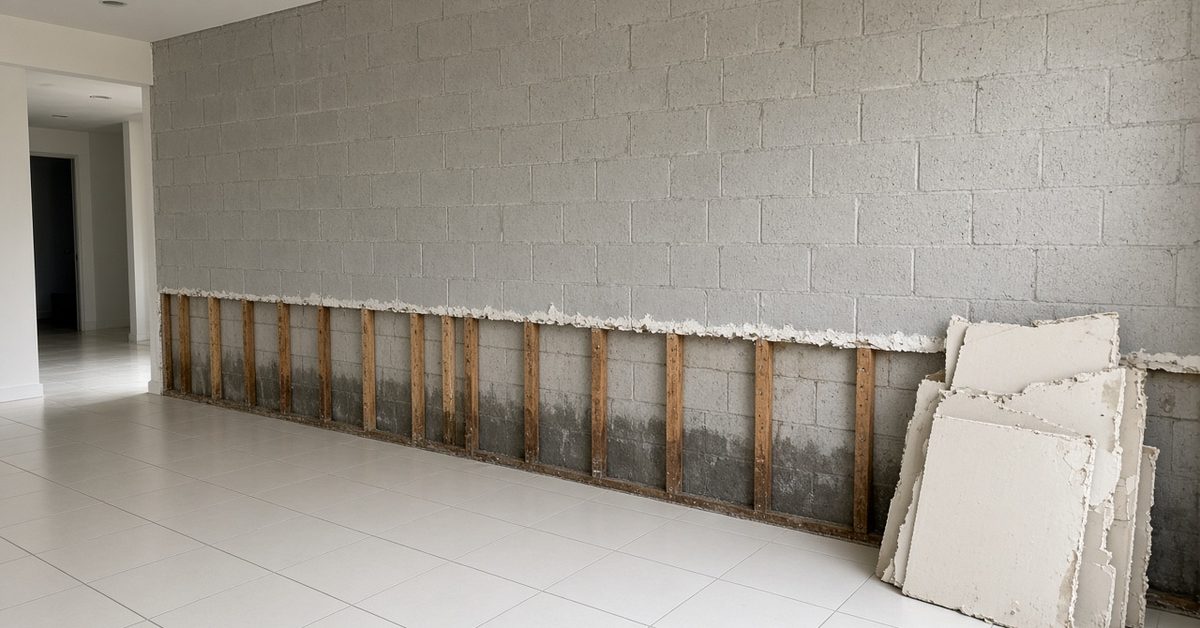
Drive through almost any neighborhood from Stuart to Vero Beach and most of the houses you see are concrete block, often called CBS construction. Builders use it here because it stands up well to wind and termites. Many homeowners assume that also means their walls are safe from water damage.
Concrete block is tough, but it is not waterproof, and the way these homes are finished inside creates some hiding places for water. Here is what makes CBS homes different, where water goes, and how they get dried out properly.
How a CBS Wall Is Built
The exterior walls are hollow concrete blocks, reinforced with steel and concrete in certain cells. On the outside, the block is covered with stucco and paint. On the inside, thin wood or metal furring strips are fastened to the block, and drywall is attached to those strips. Between the block and the drywall there is a small gap, sometimes with a thin layer of foil or foam insulation.
Interior walls in most of these homes are wood or metal framed, just like anywhere else.
Where Water Hides
When water hits the floor inside a CBS home, from a supply line, an appliance, or storm water, it runs to the base of the exterior walls and soaks into the bottom of the drywall and the furring strips. Because the gap behind the drywall is so small, air barely moves there. Water that gets into that space can stay trapped against the block for a long time.
Concrete block itself absorbs water too. It is porous, and once saturated, it releases moisture slowly. We regularly find exterior walls reading wet days after the floor looks dry.
Wind-driven rain adds another path. Cracks in stucco, failed window caulking, and gaps around doors let rain push into the block during storms. That water can show up as bubbling paint, stained drywall under windows, or swollen baseboards on exterior walls.
Warning Signs
- Paint bubbling or peeling on the inside of exterior walls
- Baseboards swelling or separating on outside walls
- Stains or tide lines under windows
- Drywall that feels soft near the floor
- Flooring that cups or lifts along exterior walls
Drying a CBS Home Properly
The biggest mistake we see is treating a block wall like it will dry on its own once the room airs out. It usually won’t, at least not fast enough to prevent damage to the drywall, trim, and flooring.
Professional water damage restoration in a CBS home starts with moisture readings along every affected wall, both the drywall and the block behind it. Wet baseboards come off. Drywall at the base of exterior walls is often cut away to expose the furring strips and the block so air can reach them. High-capacity dehumidifiers and air movers run until the block and framing test dry, not just the surface.
If the water came from outside, the source has to be fixed too. That might mean resealing windows, repairing stucco cracks, or addressing grading and gutters that send water toward the house.
Rebuilding
Once the walls are dry, the damaged finishes are replaced. Our building restoration team replaces drywall on furring strips, installs new baseboards, and matches paint and texture so you can’t tell where the repair happened. When flooring has been affected, we replace or refinish it as part of the same project.
Why Speed Matters Here
Florida’s heat and humidity work against slow drying. Indoor humidity climbs fast when the AC is struggling, and wet materials stay wet longer. Getting professional drying equipment in place within the first day or two keeps the job smaller and the repair list shorter.
Frequently Asked Questions
Do concrete block walls need to be dried after a leak?
Yes. Concrete block is porous and holds water, and the narrow space between the block and the drywall barely gets any airflow. Without targeted drying, moisture can stay trapped for weeks, damaging drywall, trim, and flooring along exterior walls.
How long does it take to dry a CBS wall?
It depends on how much water soaked in and how quickly drying started. Many jobs take four to seven days once the drywall at the base is opened and dehumidifiers are running. We take readings on both the drywall and the block to confirm the wall is actually dry, not just the surface.
Why is paint bubbling on the inside of my exterior wall?
Bubbling or peeling paint on an outside wall usually means moisture is coming through the block, often from wind-driven rain entering through stucco cracks or failed window seals. It’s worth having the wall checked with a moisture meter and fixing the outside source before repainting.
Can water get into a CBS home through the stucco?
It can. Stucco has small cracks over time, and during storms, wind can drive rain through them into the block. Keeping stucco sealed and painted, and maintaining caulking around windows and doors, cuts down on this kind of water intrusion.
Local Help
We work in concrete block homes every day, from Vero Beach down to West Palm Beach and Palm Beach Gardens. If water got into your walls, call Coastal Property Restoration at 877-853-5663. We answer around the clock.