

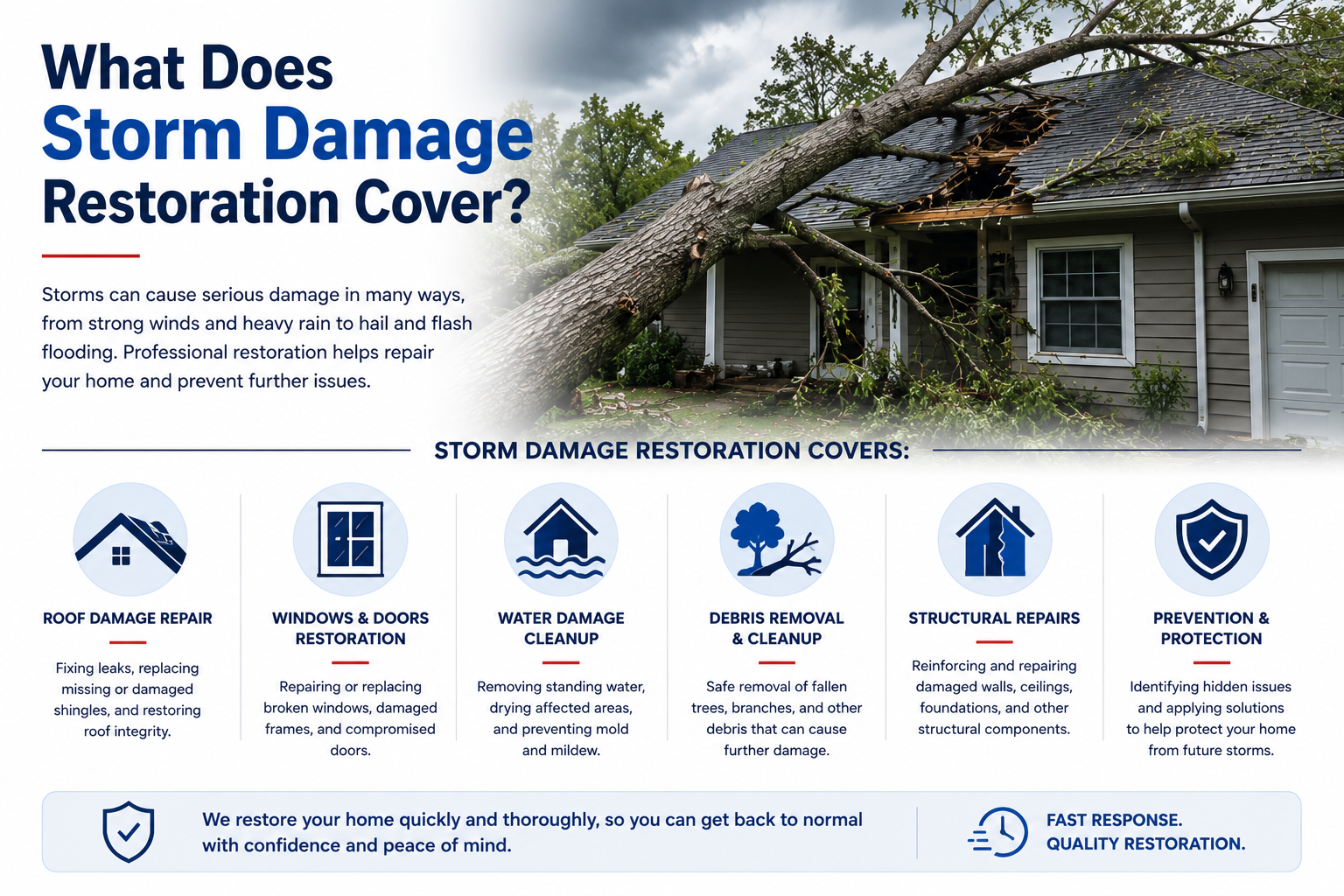
Storm damage restoration covers the full process of returning a property to pre-loss condition after wind, rain, or hail damage from a severe weather event. It includes emergency securing of the structure, damage assessment and documentation, water extraction and drying from rain intrusion, structural repairs, roof repairs or replacement, interior reconstruction, and insurance coordination. In Florida, it also frequently involves the complications that arise from high humidity, rapid mold growth, and the interaction between homeowner and flood insurance when storm surge is involved.
Here is what each component involves and what Florida property owners specifically need to understand.
Emergency Securing: The First Step
Storm damage restoration begins before any assessment work when there is an active breach in the building envelope. Board-up of damaged windows and doors and tarping of compromised roof sections stops additional weather from entering while the assessment and insurance process proceed. This step is covered under most homeowner policies as an emergency mitigation expense.
Temporary securing done correctly protects both the structure and the insurance claim. Damage that worsens because a breach was not secured before the next weather event provides the insurance company grounds to dispute the portion of the claim attributable to that secondary damage.
CPR’s storm damage response deploys emergency securing crews alongside assessment teams so both happen simultaneously rather than sequentially. In a region where weather systems can produce additional rainfall within hours of a storm event, this parallel deployment matters.
Water Intrusion After a Storm
Rain that enters through a storm-damaged roof, broken window, or compromised exterior wall is covered under most homeowner policies as a consequence of the covered storm event. This water intrusion creates a water damage scope within the storm damage loss: extraction of standing water, structural drying, selective demolition of saturated materials, and reconstruction.
In Florida’s climate, the water damage scope created by storm intrusion carries an accelerated mold risk. The combination of warm temperatures, high ambient humidity, and saturated building materials creates ideal mold growth conditions. The drying timeline that prevents mold in a drier climate may be insufficient in Florida without industrial equipment and continuous monitoring.
CPR’s water damage and storm damage services address this Florida-specific risk by calibrating drying equipment to the ambient humidity conditions rather than applying a standard protocol that assumes lower-humidity outdoor air. The daily moisture readings drive equipment adjustments that account for what the outdoor air is actually contributing to the drying process.
Roof Assessment and Repair
A storm damage restoration scope that includes roof damage covers the assessment of impact and wind damage, temporary repair to stop active water intrusion, and permanent repair or replacement as documented in the insurance-approved scope. Roof replacement after a storm requires that the insurance claim establish the connection between the storm event and the roof damage clearly enough to support the replacement cost.
Wind damage to asphalt shingles produces identifiable patterns: displaced shingles, broken adhesive seals, and damage to ridge caps and flashing that are distinct from normal aging. Hail impact produces circular impact marks and granule displacement. Documenting these patterns before any temporary repairs alter the evidence is what supports a complete roof claim.
Interior Reconstruction
Storm damage that allowed water intrusion into the interior typically requires drywall replacement, insulation replacement, flooring replacement, and paint at minimum in the affected areas. Structural repairs to framing are required where the wind or water load compromised load-bearing elements. Electrical systems affected by water intrusion require inspection and certification before they are re-enclosed.
CPR handles interior reconstruction as part of the integrated storm damage scope for property owners across the South Florida service area. Smoke damage from lightning strikes that accompany storm events is also addressed as part of the storm damage scope when applicable, preventing the need for a separate engagement for what was part of the same weather event.
Insurance Coordination for Storm Claims in Florida
Florida storm damage claims have specific considerations that property owners in other states do not face. The Florida Building Code has requirements that affect reconstruction scope and cost. Older properties may require code upgrades as part of storm damage repairs that were not part of the pre-loss condition. Assignment of benefits legislation has historically affected how restoration companies can engage with Florida insurers. Working with a restoration company that has established relationships with Florida insurers and understands the state-specific claim environment is worth understanding before signing any agreements.
CPR’s experience with hurricane damage claims and standard storm damage claims across the Florida market gives property owners a restoration partner who understands the local insurance environment, not just the restoration process.
Frequently Asked Questions
Q: What does storm damage restoration cover?
A: Storm damage restoration covers emergency securing of breaches in the building envelope, full damage assessment and documentation, water extraction and structural drying from rain intrusion through storm-created openings, roof assessment and repair or replacement, interior reconstruction of damaged materials, and insurance coordination. In coastal Florida it also frequently involves coordinating between homeowner and flood insurance when storm surge is part of the loss.
Q: How long does storm damage restoration take in Florida?
A: The timeline depends on the severity of the damage, the extent of water intrusion, and the insurance approval timeline for reconstruction. Emergency mitigation including securing and drying typically takes one to two weeks. Reconstruction depends on the scope of structural damage and material availability, ranging from a few weeks for contained losses to several months for significant structural damage requiring permits and inspections.
Q: Does homeowners insurance cover storm damage in Florida?
A: Standard homeowner policies cover wind damage, hail damage, and rain intrusion through wind-created openings. Storm surge and flooding from external sources requires separate flood insurance. Florida-specific policy considerations include wind and hurricane deductibles that may be calculated as a percentage of insured value rather than a flat amount, and code upgrade requirements that may add cost to reconstruction beyond the pre-loss condition.
Q: What is the first thing to do after storm damage to your home?
A: Document everything before touching anything. Photos and video of every affected area from the exterior to the interior. Then open the insurance claim immediately before any cleanup begins. Contact a restoration company for emergency board-up and tarping if there is any breach in the exterior. The sequence matters: documentation first, claim open second, emergency securing third, then assessment and restoration.
Storm damage to your property? Coastal Property Restoration handles emergency response through full reconstruction across the Florida service area. Call now for certified same-day response.