

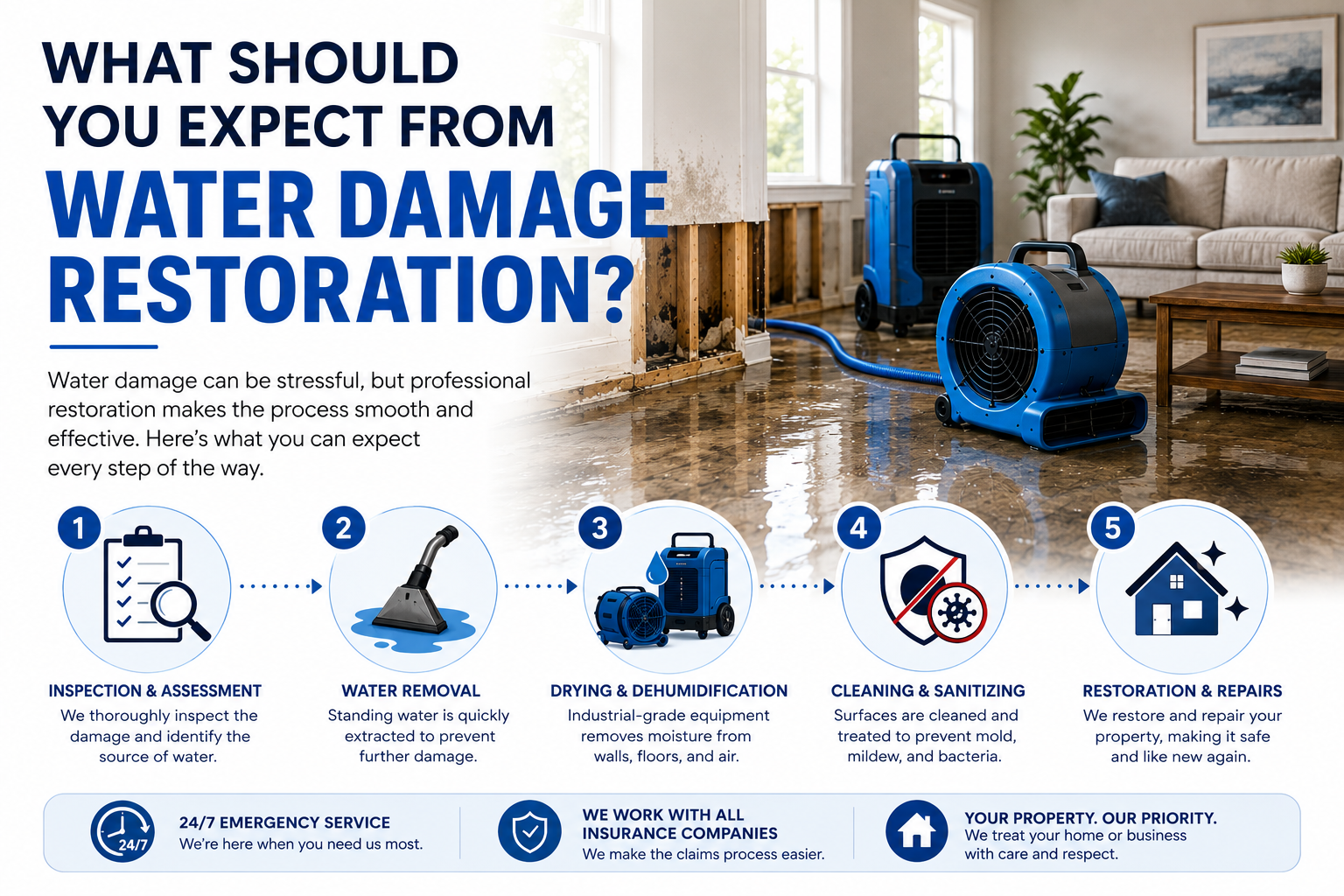
You should expect a certified restoration company to arrive with industrial extraction and drying equipment, conduct a full moisture assessment using thermal imaging and calibrated meters, extract all standing water, place drying equipment based on the moisture map rather than guesswork, return daily to take readings and adjust equipment, and provide you with documented moisture readings at every stage. You should expect direct communication about what was found, what is being done, and what the insurance documentation covers. You should not expect the process to be invisible or instantaneous.
Here is what each phase of a properly conducted water damage restoration looks like.
The First Visit: Assessment and Extraction
The first visit establishes the full scope of the loss. Before any equipment is placed, a moisture assessment maps every affected area using thermal imaging cameras and moisture meters. Thermal imaging identifies temperature differentials indicating moisture inside walls and ceilings. Moisture meters measure actual moisture content at depth in each material. The map produced determines where water has traveled, not just where it landed.
Extraction of standing water follows immediately. Industrial submersible pumps handle volume water. Truck-mounted extraction units pull water from carpet, padding, and porous flooring. Portable extractors access areas the truck-mounted unit cannot reach. The goal of the extraction phase is removing all bulk water before drying equipment is placed.
CPR’s water damage response teams arrive with extraction and assessment equipment on the same vehicle. The assessment and extraction happen in the same visit, not on sequential days. In Florida’s climate, where warm temperatures accelerate mold growth, this same-visit approach matters.
The Drying Phase: What Running Equipment Means
After extraction, industrial air movers and dehumidifiers are placed based on the moisture map. Air movers create directed high-velocity airflow that maximizes evaporation from wet material surfaces. Dehumidifiers remove the moisture evaporated into the air continuously, keeping relative humidity low enough for drying to proceed.
The equipment runs continuously, typically twenty-four hours a day, for three to five days minimum. It is loud. It moves air throughout the affected area. It creates conditions that are disruptive to daily life in the affected rooms. This is what effective drying looks like. Equipment that is quiet and unobtrusive is not doing the work.
A restoration company that is not returning daily to take moisture readings and adjust equipment is not conducting professional drying. Daily monitoring is the mechanism that confirms drying is progressing and identifies areas where additional equipment or adjustment is needed.
Selective Demolition: What Needs to Come Out
Some materials cannot be dried in place and must be removed before reconstruction. Saturated drywall, wet insulation behind walls, and structurally compromised flooring are removed once the framing they were covering reaches dry standard. This is called selective demolition and is a standard component of water damage restoration, not an indication of unusual severity.
In Florida, where high ambient humidity can slow drying of wall cavities that retain wet insulation, selective demolition to open the cavity is often the most efficient path to dry standard. CPR’s storm damage and water damage restoration experience in the Florida coastal environment means selective demolition decisions are made based on actual moisture readings and regional drying behavior, not generic protocols.
What the Documentation Looks Like
Professional water damage restoration produces a documentation package that includes the initial moisture map, daily moisture readings across all affected materials, equipment placement records, selective demolition documentation with photos, and a final moisture inspection confirming dry standard across the full scope. This documentation is the basis for the insurance claim and the evidence that the restoration was completed to professional standards.
You should receive or have access to this documentation. A restoration company that cannot produce daily moisture readings did not conduct professional drying regardless of what the finished product looks like.
For property owners navigating water damage insurance claims in Florida, the documentation package CPR provides is organized specifically for the claim process, not just for internal records. It answers the questions adjusters ask and supports the claim without requiring the homeowner to interpret technical documents and translate them for the adjuster.
The Reconstruction Phase
Reconstruction begins after the structure passes final moisture clearance. New drywall, insulation, flooring, trim, and paint replace what was removed. In Florida, reconstruction must meet current building code requirements for the work being performed, which in some cases means code upgrades that were not part of the pre-loss condition. Insurance policies typically cover code upgrade costs under ordinance or law coverage, which is a separate coverage endorsement that not all policies include.
CPR handles full reconstruction as part of the integrated water damage scope for property owners across the Florida service area. The same team that conducted mitigation carries the project through reconstruction, with the documentation record from the mitigation phase informing the reconstruction scope and supporting the insurance estimate from a consistent evidence base. Smoke damage and water damage that occur in the same event are handled under the same scope with unified documentation.
Frequently Asked Questions
Q: What should I expect from water damage restoration?
A: Expect a certified restoration company to conduct a full moisture assessment using thermal imaging and calibrated meters before placing any equipment. Expect industrial air movers and dehumidifiers running continuously for three to five days minimum. Expect daily return visits to take moisture readings and adjust equipment. Expect documentation of all findings and actions from the first visit through final dry standard clearance. Expect direct communication about what was found, what is being done, and what the insurance coverage includes.
Q: How long does water damage restoration take in Florida?
A: Structural drying with professional industrial equipment takes three to five days in most situations. Florida’s high ambient humidity can extend drying timelines compared to drier climates if equipment is not properly sized for the local conditions. Reconstruction following mitigation depends on the scope of material damage and typically adds several more days to weeks for standard residential losses. The full process from first call to completed reconstruction ranges from one to three weeks for contained losses.
Q: What does water damage restoration cost?
A: The cost depends on the scope of the loss: the extent of water intrusion, the materials affected, whether selective demolition is required, and the reconstruction scope. For most covered losses, the relevant question is what comes out of pocket after insurance: typically the deductible. Professional water damage restoration is covered under standard homeowner policies for sudden accidental water events. A certified restoration company provides a detailed estimate in the format the insurance adjuster requires for approval.
Q: Can water damage be fixed without replacing drywall?
A: Sometimes. Drywall that was wet for less than twenty-four hours and dried quickly with professional equipment may not need to be replaced if the paper facing is intact and no mold established. Drywall wet for more than forty-eight hours is typically replaced because the risk of mold in the paper layer is too high to justify retaining it. The decision is made based on actual conditions confirmed by moisture readings, not by a fixed rule about material age or cost.
Water damage in your home? Coastal Property Restoration handles the full process from assessment through reconstruction across the Florida service area. Call now for certified same-day response.