


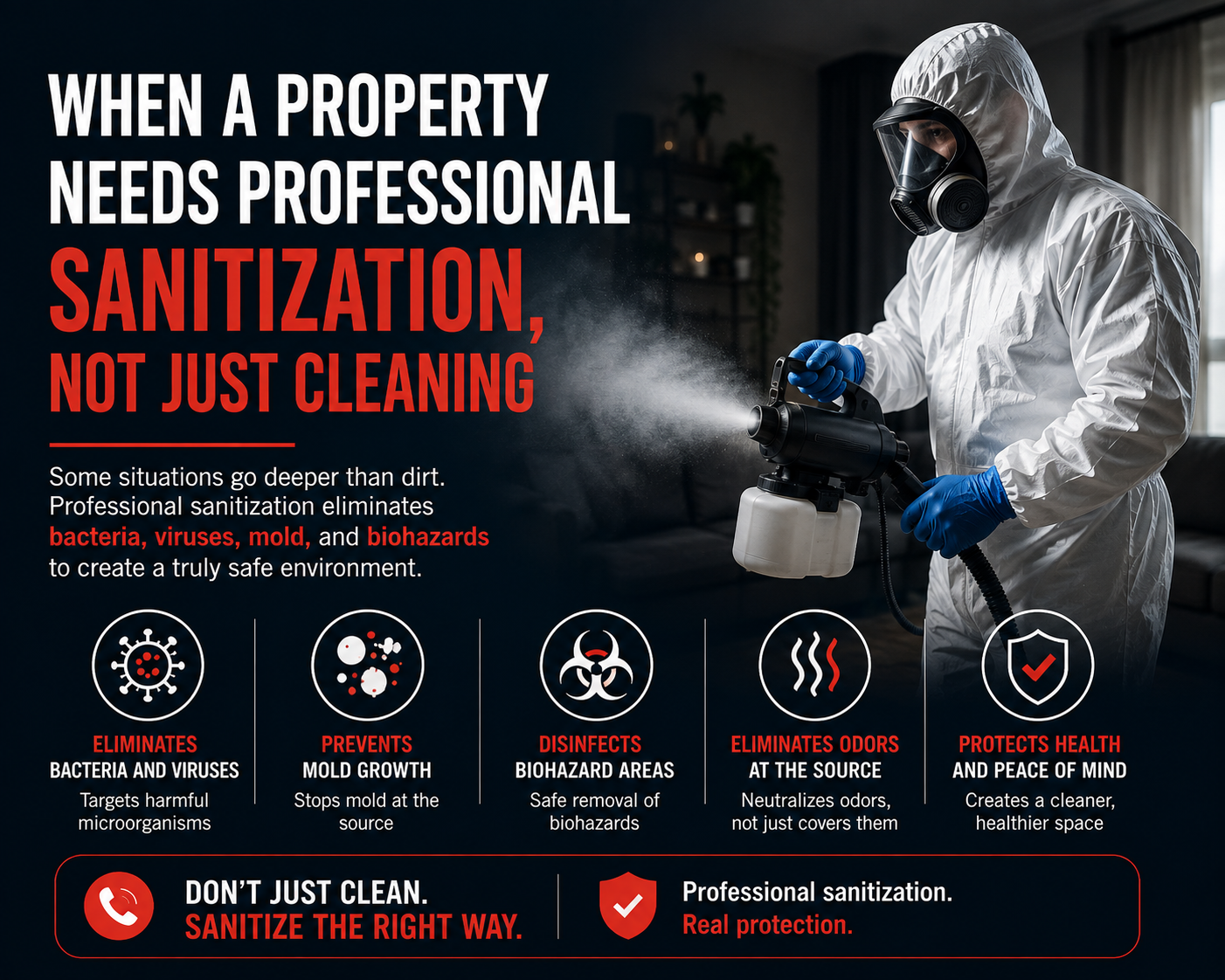
Cleaning removes visible soil. Sanitization reduces pathogens to safe levels, and disinfection eliminates them on surfaces. The three words get used interchangeably right up until a property actually needs the second or third one: a norovirus outbreak in a rental, a confirmed contagious illness in a workplace, floodwater contamination in an occupied building, or a facility that serves vulnerable populations facing a pathogen event. At that point the difference between janitorial cleaning and professional infectious disease control becomes the difference between an ended outbreak and a continuing one.
What Professional Infectious Disease Control Involves
CPR’s infectious disease control service applies EPA-registered disinfectants, selected against the specific pathogen and applied at the concentration and dwell time the registration requires, using methods that reach what wipe-downs miss: electrostatic spraying that wraps chemistry around every exposed surface, fogging for volumetric coverage in complex spaces, and manual disinfection of high-touch points in the correct sequence. Technicians work in appropriate protective equipment under containment practices that prevent the cleanup itself from spreading contamination.
Dwell Time: The Detail That Separates Real Disinfection From Theater
Every registered disinfectant has a required wet contact time, often several minutes, during which the surface must stay visibly wet for the kill claim to hold. Spraying and immediately wiping, the standard janitorial motion, delivers a fraction of that contact and a fraction of the result. Professional application is built around dwell time: chemistry chosen for the pathogen, applied to stay wet as long as its registration requires, verified rather than assumed.
The Situations That Call for It
- Outbreak response: norovirus, flu clusters, or other contagious illness events in workplaces, schools, gyms, and rentals
- Post-flood contamination: category two and three water events leave biological contamination that drying alone does not address
- Vulnerable-population facilities: childcare, eldercare, and medical-adjacent spaces where pathogen events carry outsized consequences
- Vacation rentals and hospitality: guest-illness events where the next check-in is days away and documentation matters
- Reopening after any biohazard event, where proof of professional treatment is the operational requirement
Documentation: The Part Businesses Actually Need
For a business, the sanitization itself is half the deliverable. The other half is the record: what was treated, with which EPA-registered products, at what concentrations, on what date, by whom. That documentation answers employees, customers, health departments, and in hospitality, the guest review that asks what the property did. CPR produces it as a standard part of every engagement, the same documentation discipline it applies across its commercial restoration work.
Where It Meets Water Damage
Florida’s flood events make infectious disease control a routine companion to water restoration: surge and street flooding carry sewage and biological contamination into buildings, and the correct scope pairs extraction and drying with disinfection of every surface the water touched. A water damage response that dries without disinfecting leaves the contamination in place, invisible and active. CPR scopes contaminated-water events as combined engagements from the first assessment.
Frequently Asked Questions
Q: What is the difference between cleaning, sanitizing, and disinfecting?
A: Cleaning removes visible soil and some microorganisms mechanically. Sanitizing reduces pathogens to levels considered safe by public health standards. Disinfecting kills specified organisms on surfaces using EPA-registered chemistry applied per its label, including required wet dwell time. Pathogen events call for disinfection, and disinfection without proper dwell time is functionally just cleaning.
Q: When does a business need professional disinfection instead of janitorial cleaning?
A: After a confirmed or suspected contagious illness event, after any contaminated water intrusion, before reopening a space that served a symptomatic person in vulnerable-population settings, and any time documentation of pathogen treatment will be required by health authorities, employees, or customers. Janitorial cleaning maintains; professional disinfection responds to events.
Q: Is fogging or electrostatic spraying better than wiping surfaces?
A: They solve different problems. Electrostatic application wraps charged droplets around exposed surfaces including undersides and complex geometry, and fogging treats volume, while manual disinfection with proper dwell remains essential for high-touch points. Professional protocols combine them; none of them substitutes for correct chemistry and contact time, which is where non-professional fogging services typically fail.
Q: Does flood water really require disinfection after drying?
A: Yes, for water that entered from outside or through sewage pathways. Category two and three water deposits bacteria, viruses, and organic contamination on every surface it contacts, and drying removes the moisture while leaving the biology. Professional scope for contaminated water pairs structural drying with surface disinfection and, where warranted, post-treatment verification.
Pathogen event or contaminated flooding at your Florida property? CPR provides professional infectious disease control with full documentation. Call now.