


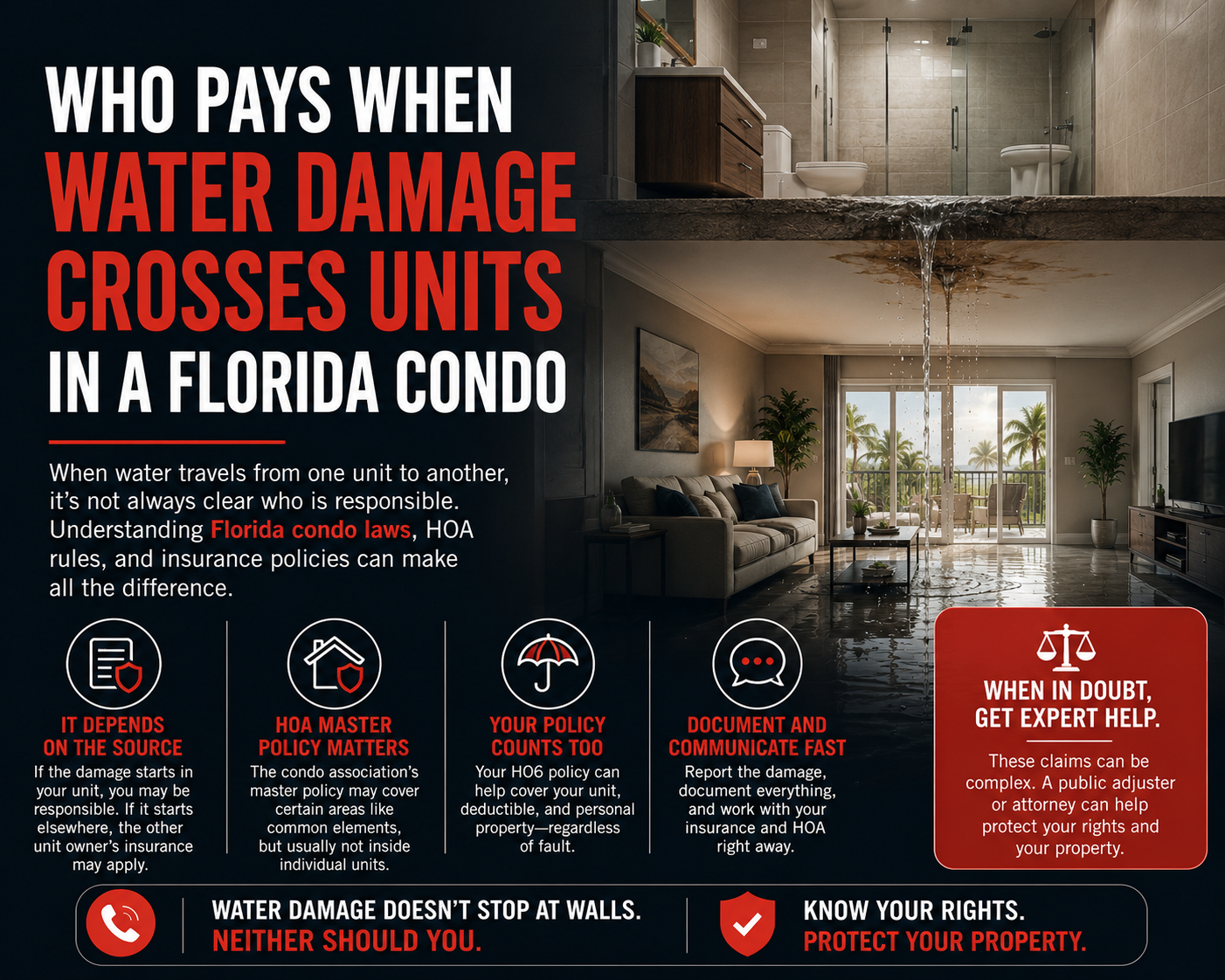
A supply line fails in unit 802 on a Friday night, and by Saturday morning units 702, 602, and 502 have wet ceilings, the hallway carpet is soaked, and four owners plus an association are asking the same question: whose problem is this? Florida condominium water losses are the most jurisdictionally tangled events in residential restoration, because the answer is split across statute, the association’s declaration, and multiple insurance policies, and because the restoration cannot wait for the question to be settled. Understanding the framework before a loss is the difference between a coordinated recovery and a four-way standoff over wet drywall.
The Florida Framework: Who Insures What
Florida statute draws the default line: the association’s policy covers the building as originally built, structure, drywall in place, common elements, while each unit owner covers everything from the unfinished drywall inward, paint, flooring, cabinets, fixtures, personal property, and improvements. The association’s declaration can adjust details, but the statutory pattern governs most buildings. Practically: the ceiling drywall in 702 is likely association scope; the paint on it, the flooring below it, and the furniture under it are the owner’s.
Responsibility Versus Coverage: The Distinction That Prevents Fights
Whose insurance covers a surface is a different question from who caused the loss. The owner of the failed supply line is not automatically liable for every unit below; Florida generally requires negligence, a known problem ignored, maintenance skipped, for cause-based liability to attach. Most multi-unit losses therefore resolve as each policy covering its own layer, with subrogation between carriers where negligence exists. Owners who understand this stop waiting for 802 to pay and start their own claims immediately, which is what the timeline requires anyway.
Why the Restoration Cannot Wait for the Answer
Wet assemblies in a Florida building are on the mold clock regardless of whose adjuster is assigned. The correct sequence is mitigation first, allocation second: emergency extraction and drying across all affected units under documented moisture mapping, with the record of what was wet, where, and how it traveled preserved for every subsequent claim. CPR’s water damage teams work multi-unit losses as a single coordinated drying project across units and common areas, producing the unified moisture documentation that four separate contractors hired by four separate parties never manage to assemble.
The Association’s Role, and the Manager’s First Hour
The association controls common elements and typically the building systems, which makes it the party that authorizes emergency access, coordinates unit entry, and engages restoration for the shared scope. The manager’s first-hour checklist: stop the source, authorize mitigation across the affected stack, notify every potentially affected owner in writing including units that look dry, and open the association’s claim. Buildings with pre-loss vendor relationships execute this in an hour; buildings without them lose the weekend. CPR maintains response agreements with Florida associations through its commercial program for exactly this reason.
Mold: Where Delay Gets Expensive and Contested
The contested condo losses are rarely about the water; they are about the mold that followed slow response, growth inside assemblies between units, discovered weeks later, with each party attributing it to another’s delay. The prevention is speed plus records: same-weekend drying with daily moisture logs ends most of these disputes before they form. Where growth has already established, CPR’s mold removal scope addresses it with the containment and clearance documentation that unit sales and association records will later require.
Frequently Asked Questions
Q: Who pays for ceiling damage in my condo from the unit above?
A: In most Florida buildings, the association’s policy covers the ceiling drywall as part of the building as originally built, while your policy covers the paint, any flooring or contents damaged below, and improvements. The upstairs owner’s liability requires negligence, not mere ownership of the failed component. File your own claim immediately rather than waiting on theirs; carriers sort recovery between themselves afterward.
Q: Does the condo association have to fix water damage inside my unit?
A: The association’s obligation generally runs to common elements and the building as originally built, which usually includes bare drywall but not your finishes, flooring, cabinets, or property. Your HO-6 policy exists for that interior layer. The declaration can shift specific items, so the governing documents are always worth checking, but no owner should assume the association’s scope covers their renovation.
Q: Can I hire my own restoration company for my unit in a multi-unit loss?
A: Yes, for your interior scope, though multi-unit losses dry best as one coordinated project: moisture travels through shared assemblies that unit-by-unit contractors each see only part of. The strongest pattern is association-engaged mitigation across the affected stack with unified documentation, with each owner’s finish restoration proceeding on their own claim afterward.
Q: What should a property manager do first in a condo water loss?
A: Stop the source, authorize emergency mitigation across every potentially affected unit, notify all owners in the affected stack in writing including those without visible damage, and open the association claim, all within hours. The mold clock runs on the building’s timeline, not the insurance timeline, and written notification protects the association when a unit owner declines access and damage compounds behind their door.
Multi-unit water loss in your Florida condo or HOA building? CPR coordinates mitigation across units with the documentation every claim will need. Call now.